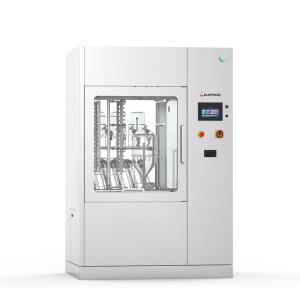
Stainless steel GMP washer
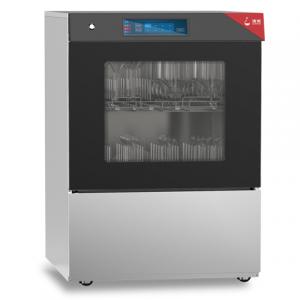
At six in the morning, the strip lights in a sterile preparation workshop flicker on one by one. Engineer Chen presses the start button on the console, and a stainless steel GMP (Good Manufacturing Practice) washer, gleaming like a mirror, slowly begins to rotate. This marks the most critical “clearance” phase before pharmaceutical production begins. From vials to freeze-drying trays, from mixing tanks to filling needles, every equipment component that comes into direct contact with the drug will complete a life-and-death struggle against microorganisms inside this machine. In the pharmaceutical industry, GMP standards hang over production like the Sword of Damocles, and the stainless steel GMP washer is the first line of defense, the “invisible guardian” of drug safety.
Why Stainless Steel? A “Two-Way Street” Between Material and Regulation
Pharmaceutical equipment is notoriously picky about materials, and stainless steel’s status as the “absolute protagonist” of GMP washers is by no means accidental.
“The fact that stainless steel doesn’t ‘rust’ is just the surface; its true essence is ‘cleanliness,’” says Engineer Chen, running his hand over the inner wall of the washer. His fingertips meet a cool touch—the surface is mirror-polished 316L stainless steel, with a surface roughness (Ra) controlled below 0.4μm, smoother than a baby’s skin. “This material barely adsorbs drug residues, and unlike carbon steel, it won’t rust and generate metal ions. If those got into an injection, it would be a fatal contamination risk.” He adds that 316L stainless steel, due to the addition of molybdenum, has extremely strong corrosion resistance to common cleaning agents like citric acid and sodium hydroxide. Even when exposed to acid and alkaline solutions daily, the surface remains as bright as new ten years later.
GMP regulations explicitly stipulate that surfaces in contact with drugs must be non-toxic, corrosion-resistant, and must not react with or adsorb the drug. Stainless steel not only matches this perfectly but also aligns deeply with the GMP philosophy of “pollution prevention” in its structural design. All welds on the washer are fully welded and polished, leaving not a single gap; corners are designed with arcs of no less than 135 degrees to avoid dead corners where microorganisms might breed; even the slope of the drainage pipe is precisely calculated to ensure not a single drop of liquid remains after cleaning. “Every detail is saying ‘no’ to microorganisms,” Chen says with a smile.
More Than Just “Clean”: The Technical “Shadow War” of GMP washers
“Many people think a washer is just a ‘giant dishwasher,’ but the technological gap between the two is more than one dimension,” says Chen, pointing to the dense parameters on the washer’s console. A qualified GMP washer must simultaneously solve three major challenges: “cleaning effectively,” “verifying clearly,” and “tracing completely.” Each is a tough battle of technology.
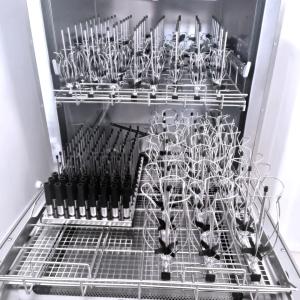
Cleaning effectively relies on a “three-dimensional strike.” Inside the washer, high-pressure spraying, ultrasonic oscillation, and hot water soaking work in synergy: high-pressure nozzles spray cleaning liquid onto the equipment surface at 0.8MPa to wash away visible stains; 40kHz ultrasound creates a “cavitation effect” in the liquid, using the energy of countless bursting micro-bubbles to disintegrate stubborn residues; 85°C hot water kills most heat-resistant microorganisms. For different pollutants, the washer can automatically switch cleaning agents—alkaline agents for protein residues, acidic agents for lipid-soluble substances, and even endotoxins (bacterial toxins), the most difficult opponent, can be reduced to below 0.25EU/mL using specialized agents, meeting the cleanliness standards for injections.
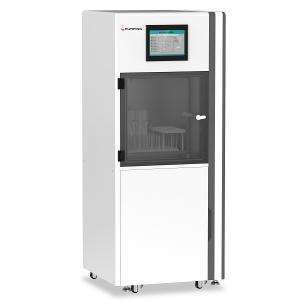
Verifying clearly relies on “data speaking.” GMP requires that cleaning effects be verifiable. This washer is equipped with an online conductivity meter and a TOC (Total Organic Carbon) analyzer to monitor the cleanliness of the cleaning liquid in real-time. “In the past, we relied on manual sampling and lab testing; by the time results came back, half a day might have passed. Now the machine performs a ‘physical exam’ itself; it’s only considered qualified if conductivity is ≤1.33μS/cm and TOC ≤0.25ppm. The data is uploaded directly to the system, making it ten times more accurate than humans.” Chen displays a cleaning report: after washing vials, the residual Active Pharmaceutical Ingredient (API) on the surface was 0.001μg/vial, far below the GMP standard of “not detected.”
Tracing completely relies on “full retention.” Every piece of data from a batch of cleaning—time, temperature, pressure, cleaning agent dosage, test results—is automatically recorded by the machine, generating unalterable electronic records. “When the drug administration inspects, they can pull up this report and see clearly ‘who washed this bottle, how it was washed, and if it was qualified.’ This is the ‘traceability’ of GMP.” Chen clicks into the system, where tens of thousands of cleaning records from December 2023 are visible at a glance, down to the operator’s ID number.
From APIs to Biopharma: A Customized “Bespoke” Cleaning Service
Different pharmaceutical production scenarios have vastly different cleaning needs, and the “wisdom” of a stainless steel GMP washer lies in its ability to be “tailor-made.”
In API (Active Pharmaceutical Ingredient) workshops, the objects to be cleaned are large equipment like reactors and crystallization tanks, whose surfaces may be covered with highly potent drug dust. Here, a “spray ball + rotary brush” combination is used: the spray ball handles large-scale rinsing, while the rotary brush reaches deep inside the tank to mechanically remove stubborn scale. “Last year, a client produced an anti-tumor drug with extremely toxic residues. We specially designed a ‘double-sealed cleaning chamber’ so operators could complete disassembly and assembly behind the door, avoiding contact contamination,” Chen recalls.
In sterile preparation workshops, the focus is on “depypyrogenation” (removal of pyrogens). Excessive pyrogens in injections can cause febrile shock in patients, so washed vials and stoppers must undergo high-temperature sterilization at 121°C. The “tunnel drying and sterilization” module on this washer allows items to stay in 320°C hot air for 5 minutes, completely destroying the pyrogen structure, achieving a sterilization pass rate of 100%.
In the field of biopharmaceuticals, the challenge escalates to “gentle cleaning.” Bioreactors used for cell culture have delicate cell proteins attached to their inner walls; strong acids or alkalis cannot be used, or they will damage the biocompatible coating on the equipment surface. “We developed a ‘neutral enzyme cleaner + low-temperature ultrasound’ process that removes protein residues gently at 40°C, extending the service life of the equipment coating,” says Chen. After a vaccine enterprise used it, cleaning efficiency increased by 30%, and equipment maintenance costs dropped by 20%.
The Invisible Guardian: When GMP is Etched into the Machine’s “DNA”
At three in the morning, the last washer in the workshop completes its cycle. Chen looks at the “Cleaning Qualified” message on the screen and breathes a sigh of relief. He knows that this stainless steel GMP washer has not only cleaned the equipment but also washed away the “hidden dangers” of drug safety.
From the initial implementation of China’s GMP regulations in 1998, to the revision in 2010 aligning with international standards, and now the upcoming latest version in 2025, the technological iteration of washers has always followed in the footsteps of regulations. From initial manual cleaning to semi-automatic, and now to today’s intelligent, fully traceable systems, the stainless steel GMP washer is no longer just a simple machine; it is the “embodiment” of the GMP philosophy. Every inch of its stainless steel material writes “safety,” every sensor watches over “quality,” and every data point brands “responsibility.”
“Pharmaceutical people often say, ‘Quality is produced, not tested.’ The GMP washer is the most basic ‘quality line of defense’ in the production process,” says Chen as he turns off the console. The machine’s silver shell gleams under the lights, like a silent guardian, waiting for the next “clearance” battle at dawn.
In this silent contest against microorganisms, the stainless steel GMP washer uses the toughest materials to bear the softest responsibilities. What it washes is equipment; what it guards is the life and health of every patient.
Related News