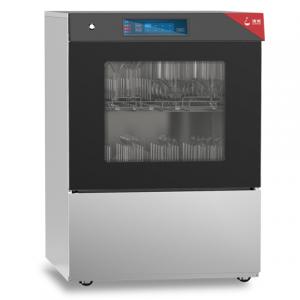
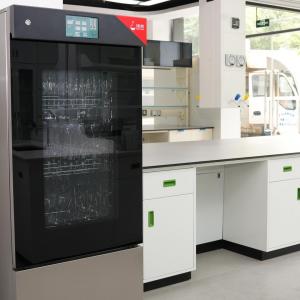
The Stoichiometric Wash: Redefining Cycle Time for Heavy Organic Residues in Laboratory Glassware Washers
The industry standard for a heavily soiled wash cycle in a laboratory glassware washer—typically cited as 60 to 90 minutes—is largely an arbitrary metric born of convenience rather than chemical necessity. When dealing with heavy organic residues (lipids, polymerized oils, heavy hydrocarbons, and persistent synthetic byproducts), a time-based paradigm is fundamentally flawed. This paper proposes that the “standard cycle time” is a myth; the true metric must be derived from the stoichiometry of hydrolysis and the kinetics of surfactant emulsification. By transitioning to a Chemically-Informed Adaptive Cycle (CIAC), effective cycle times can be both extended for complete digestion and compressed for operational efficiency.
1. Introduction: The Tyranny of the Timer
Ask a lab manager the standard wash cycle time for heavily soiled organic glassware, and the answer will usually range from 90 to 120 minutes. This figure represents a compromise: it is long enough to appease the chemist that “something is happening,” but short enough to ensure the washer is free for the next shift. However, organic residues do not adhere to human schedules. The saponification of a heavy lipid or the hydrolysis of a cross-linked polymer operates on chemical kinetics, not a timer. Relying on a fixed standard cycle time guarantees only two outcomes: under-washed glassware (if the chemistry is slower than the timer) or wasted energy and degraded glassware (if the chemistry finishes in 45 minutes but the timer is set for 120).
2. The Chemistry of Organic Removal: Hydrolysis and Emulsification
Heavy organic soils are predominantly hydrophobic. They resist water-based removal through two mechanisms: low surface energy (they do not wet easily) and high binding energy to the glass silanol groups.
Removal requires a two-step chemical process:
- Alkaline Hydrolysis: Sodium hydroxide or potassium hydroxide must chemically attack the organic ester bonds, breaking the macro-molecule into smaller, water-soluble fragments (saponification). This reaction is highly temperature-dependent (Arrhenius equation). At 60°C, the hydrolysis of heavy lipid might take 45 minutes; at 90°C, it may take 12 minutes.
- Surfactant Emulsification: Once fragmented, non-ionic surfactants must encapsulate the hydrophobic tails, forming micelles that can be suspended in the wash water and drained.
If the wash cycle ends before hydrolysis is complete, emulsification cannot occur. The result is a smeared, opaque film on the glassware. Therefore, a “standard time” is irrelevant without knowing the exact stoichiometric ratio of alkali to soil mass.
3. The Stoichiometric Wash Paradigm
Instead of a fixed timer, the industry must adopt a Stoichiometric Wash Paradigm. The duration of the main wash phase should be dictated by the time required for the molar equivalent of the alkali to be consumed by the soil.
In a heavily soiled organic load, the initial alkali concentration drops rapidly as it reacts with the organic matrix. If we monitor the pH and conductivity in real-time, the cycle time becomes dynamic. The “standard” cycle is no longer a fixed duration; it is the *time to equilibrium*. When the pH and conductivity stabilize, it indicates that the hydrolysis reaction has reached completion, the surfactants have emulsified the remnants, and the water is holding the maximum micelle load. At this precise moment, the wash water must be drained. Continuing to wash past this point merely redeposits the emulsified organics back onto the glass (re-deposition effect).
4. Oxidative Augmentation: Compressing the Kinetic Timeline
If the stoichiometric timeline results in an unacceptably long cycle (e.g., >180 minutes for polymerized oils), the solution is not to extend the time, but to augment the chemistry to accelerate the kinetics.
The introduction of oxidative chemistry—specifically, the injection of hydrogen peroxide or peracetic acid in tandem with alkali—radically alters the cycle time. The hydroxyl radicals generated attack the carbon-carbon double bonds in the organic residue, bypassing the slower saponification route. In a washer equipped with an oxidative injection module, the “standard” cycle for heavily soiled organic glassware can be compressed from 120 minutes down to approximately 55-65 minutes, because the chemical digestion rate is exponentially increased.
5. Conclusion
What is the standard wash cycle time for heavily soiled organic residues? The expert answer is: *The exact time it takes for alkaline hydrolysis to reach stoichiometric equilibrium.* While a nominal baseline of 90-120 minutes exists in manufacturer manuals, this is an artifact of pre-set timers. The future of laboratory glassware washing lies in adaptive, sensor-driven cycles that measure pH and conductivity to determine the exact second soil digestion is complete. By respecting chemical kinetics over chronological convention, we ensure pristine glassware while optimizing laboratory throughput.