
Defying Gravity and Surface Tension: Can a Laboratory Glassware Washer Clean Narrow-Neck Volumetric Flasks Effectively?
There is a particular frustration known to every analytical chemist: holding a Class A volumetric flask up to the light, only to see a microscopic speck of residue stubbornly clinging to the curve at the very bottom, miles away from the narrow neck. The volumetric flask is a marvel of volumetric precision, but its geometry is a nightmare for cleaning. The narrow neck restricts access, limits water flow, and creates a surface-tension trap that prevents water from effectively reaching the heel of the flask.
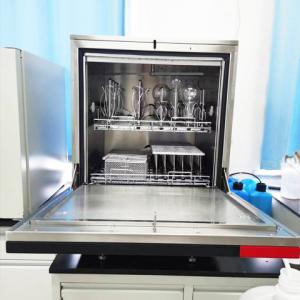
So, when faced with the prospect of automating this chore, a valid question arises: Can a laboratory glassware washer truly clean narrow-neck volumetric flasks effectively? The short answer is yes—but only if the machine is engineered to defeat the physics of the flask.
The Physics of the Problem
To understand how to clean a volumetric flask, we must understand why it is so hard to clean in the first place. When water is sprayed into a flask from above, the narrow neck creates a Venturi effect, accelerating the fluid. However, this high-velocity stream often shoots straight to the bottom and splashes back, missing the curved lower walls entirely. Furthermore, surface tension causes the water to form a meniscus that bridges the narrow gap of the neck, preventing air from escaping and creating an airlock that stops water from filling the chamber.
The Solution: Direct Injection Spindles
A standard laboratory washer with rotating spray arms beneath a generic basket will never adequately clean a narrow-neck flask. The spray simply cannot defy gravity and surface tension to reach the inner heel.
To clean volumetric flasks effectively, a washer must utilize a direct injection spindle rack. In this system, the flasks are inverted, and individual nozzles (spindles) physically insert up into the neck of each flask. By injecting water and detergent directly into the confined space, the washer bypasses the airlock issue. The fluid is forced under pressure against the heel and lower sidewalls, physically displacing the soil. If your washer does not have a spindle rack designed for your specific flask sizes, your volumetric flasks will not get clean.
The Chemistry of the Confined Space
Because the volume of water inside a narrow-neck flask is small relative to its surface area, the chemical action of the detergent is highly concentrated but easily depleted. If organic residues are present, the small volume of water inside the flask can quickly become saturated, ceasing to dissolve further soil.
Therefore, an effective washer must feature high-flow, multi-cycle spindle injection. It must flush the flask repeatedly with fresh detergent solution to continuously replenish the chemical action. Low-foaming, high-surfactant laboratory detergents are critical here; foam expands and occupies the limited volume inside the flask, pushing the cleaning solution out and leaving residues behind.
The Drying Dilemma
Washing is only half the battle. Drying a narrow-neck volumetric flask is notoriously difficult. Gravity pulls the rinse water down, where it pools in the tight curve of the heel, and the narrow neck prevents natural evaporation. If a washer relies solely on residual heat to dry the glassware, the flasks will emerge with water spots—or worse, standing water—at the bottom.
A capable washer must feature active, forced-air drying channeled directly through the spindles. Blowing warm, HEPA-filtered air up into the inverted flask forces the water out and rapidly evaporates the microscopic film, ensuring a spot-free, analytically pristine interior.
Conclusion
So, can a laboratory glassware washer clean narrow-neck volumetric flasks effectively? Absolutely. But it requires more than just hot water and soap. It requires a machine specifically designed to combat the unique physics of the vessel—using direct injection spindles to break surface tension, high-flow detergent cycles to overcome limited volume, and forced-air drying through the neck to evict stubborn water droplets. Choose your washer based on its physics, not its price tag, and you will never have to squint at a dirty flask heel again.
Related News